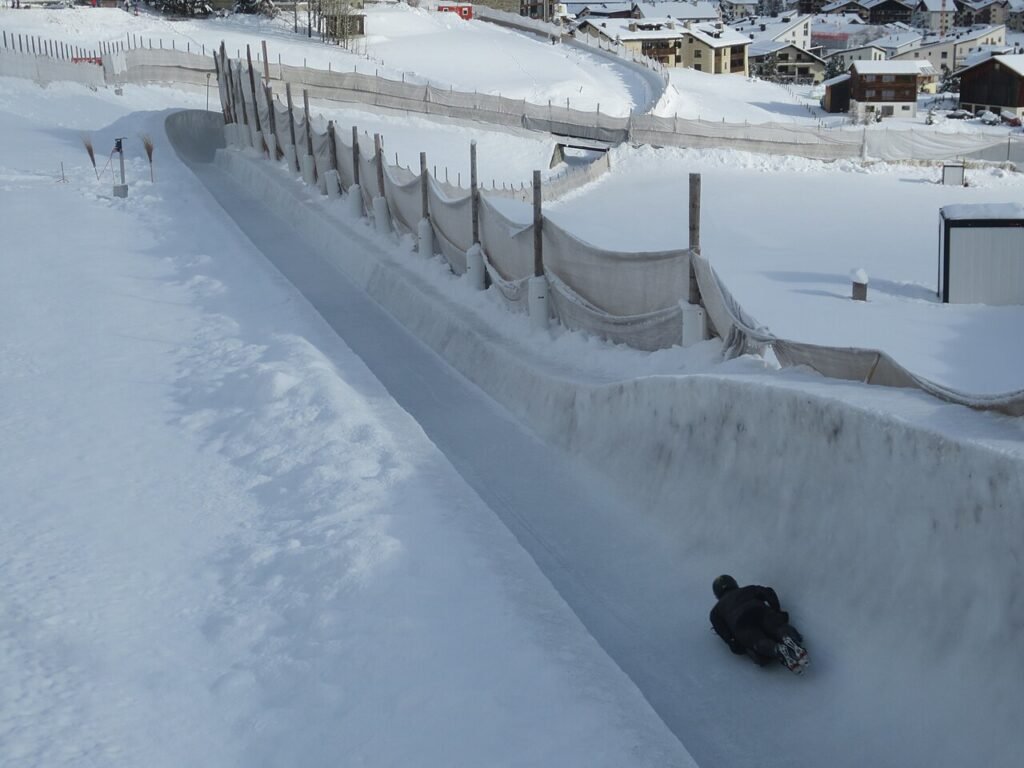
As the northern winter sets in, one of the world’s strangest sporting traditions is preparing for another season in the Swiss resort town of St Moritz.
On the Cresta Run, amateur riders lie face-down on a heavy steel sled and travel head-first down a twisting chute of natural ice. Races generally run from just before Christmas until late February, for as long as the weather allows.
The track
The run was built in 1884 and is one of very few tracks in the world used only for skeleton, the head-first form of sledding. It is about 1.2 kilometres long and falls 157 metres from top to bottom.
Average speeds are above 80 km/h, and experienced riders starting from the very top leave the track at around 130 km/h. There are no brakes. Riders steer by shifting their weight and slow down by dragging spikes on the toes of their boots.
The corner riders fear
The best-known section is Shuttlecock, a tight bend where riders who take the wrong line are thrown off the ice. Those who come off there qualify for the Shuttlecock Club, which holds its own annual dinner.
A very old club
The track is run by the St Moritz Tobogganing Club, founded in 1887, in partnership with the town. Members are elected.
Riders did not always go head-first. A rider named Cornish introduced the style in the 1887 Grand National race, and by 1890 every competitor had adopted it.
Skeleton was contested on the Cresta at the 1928 and 1948 Winter Olympics. They were the only Games to include the sport until it returned at Salt Lake City in 2002, on a conventional sliding track.
A long-running ban
Women rode the Cresta in its early years, but from 1929 they were barred. The ban lasted almost 90 years, until December 2018. In 2019, Carina Evans became the first woman to ride from the top since it was lifted.
For visitors
Spectators can watch from beside the track. For Australians heading to the Alps this summer, St Moritz offers a rare chance to see a sport that has barely changed since the 19th century.



Join the conversation